The Psychology of the Man-Child – Profound Quotes and Passages
The Psychology of the Man-Child – Profound Quotes and Passages
Categories: QuotesIn 1959, the Swiss psychologist Marie-Louise von Franz delivered a series of lectures examining the psychology of the man-child, as she observed:
“…he remains too long in adolescent psychology; that is, all those characteristics that are normal in a youth of seventeen or eighteen are continued into later life, coupled in most cases with too great a dependence on the mother.”
Marie-Louise von Franz, The Problem of the Puer Aeternus
Today there is an epidemic of the man-child neurosis. Many men are struggling socially, spiritually, financially, and sexually. They are living at home into their late 20s and 30s, choosing to remain in the comfortable confines of their parents’ care instead of testing the uncertain waters of independence. Rather than taking risks in the real world and struggling to create something of themselves, many men are losing themselves in the virtual worlds of social media, pornography, and video games. Such men are passive drifters with no path or purpose, save the pursuit of momentary pleasure to distract from suffering.
Below find some insightful quotes and passages that will help you understand the suffering and struggles of the man-child, and what is required to overcome this neurotic condition.
The Psychology of the Man-Child 6-part series (over 2 hours of content)
Healthy Masculinity Must Be Achieved – It Does not Arise Naturally
While the development of femininity is promoted by a girl’s early bond with the mother and solidified by the onset of menstruation and the role nature has conferred on her as the bearer and caregiver of children, there are no natural markers nor biological roles that confer masculinity upon men.
Authentic masculinity, or what is called manhood, is a precarious state that must be fought for and achieved. For the Fox Tribe of Iowa, for example, the attainment of manhood is called “the Big Impossible”.
“Nobody was born a man; you earned manhood provided you were good enough, bold enough.”
Norman Mailer, Armies of the Night
“In every age, not just our own, manhood was something that had to be won.”
Leonard Kriegel, Of Men and Manhood
Masculinity is an accomplishment, not a birthright—so strong is the pull of mother.”
Eugene Monick, Castration and Male Rage
“In most societies, there is a constantly recurring notion that real manhood is different from anatomical maleness, that it is not a natural condition that comes about spontaneously through biological maturation but rather is a precarious or artificial state that boys must win against powerful odds. This recurrent notion that manhood is problematic, is found among the simplest hunters and fishermen, among peasants and sophisticated urban people; it is found in all continents and environments.”
David Gilmore Manhood in the Making
Boys are Burdened with Regressive Desires to Remain Dependent on the Mother
“The personal mother is the source from which we emerge, having shared her blood, floated in her amniotic seas and resonated to her neurological network. Even after separation, we reflexively long for reconnection.”
James Hollis, Under Saturn’s Shadow
“Regression is the tendency to return to prior states of development, to evade reality. The wish escape, to run from danger, to seek solace at mother’s side.”
David Gilmore, Manhood in the Making
As the boy transitions to manhood…a part of him continues to yearn for the lost union with the mother. He must, however, be vigilant against such regressive and forbidden urges.”
David Gilmore, Manhood in the Making
“The anthropologist Thomas Gregor refers to the universal desire of men to take “the path back to fusion with the mother and the pleasures of infancy””
David Gilmore, Manhood in the Making
“…the spirit of regression threatens us with bondage to the mother and with dissolution and extinction in the unconscious.”
Carl Jung, Symbols of Transformation
Society Must Turn Boys Into Men
Because boys harbor regressive wishes to remain dependent on the mother, societal institutions throughout history have helped transition boys from boyhood to manhood.
“Manhood is a solemn thing. It is not purely natural, for like most of the attributes of a civilized society it has to be taught.”
Peter Stearns, Be a Man!: Males in Modern Society
“…while girls develop womanhood naturally because they retain ties to their mothers, boys have to be “grown” into men by cultural means: “masculinity must be achieved”.”
David Gilmore, Manhood in the Making
“Whereas nature turns girls into women, society has to make boys into men.”
Anthony Stevens, Archetype Revisited
Making Boys into Men – Rites of Initiation

All premodern or traditional societies have accorded the greatest significance to rites of passage, whose purpose is to initiate boys into manhood. A rite of passage was led by the male elders of the community and it was obligatory for all adolescent boys. A boy who tried to evade a rite of passage, or who failed to complete it, was shunned, ridiculed, and in some cases exiled from the community.
“Thus we see why our ancestors had such powerful rites of passage. They knew all too well the regressive power of the psyche, the longing for the safety and satiety of the Mother. As great as is the inner pressure, the deep pull back and down into the realm of the Mother, so must a corresponding force emerge to bridge the psyche over the great-in-between. This was the wisdom embodied in tribal rites of passage out of childhood.”
James Hollis, Under Saturn’s Shadow
Ritual Wounding – Why Boys Must Suffer to Become Men
Central to a rite of passage is a ritual wounding. In some cultures, the male elders use a chisel and hammer to knock out one of the boy’s teeth. In other tribes, the boy is forced to sit naked on a mound of fire ants and poisonous plants. In one of the more brutal ritual woundings, which occurs in a tribe of New Guinea, long, sharp, and rigid pieces of grass are thrust up the boy’s nose until blood comes gushing out. The anthropologist Gilbert Herdt, who witnessed this wounding, called it:
“…the single most painful, ritual act and probably close to an authentic physical and psychological trauma.”
Gilbert Herdt, Rituals of Manhood
While this wounding may appear unnecessarily cruel or violent, our ancestors realized that difficult and painful trials are required for a boy to break free from his regressive desires to remain dependent on the mother.
“The woundings that occur during initiations can be rejected as brutal, but I would argue that greater brutality results where there are no “ordeals of meaning”.”
Michael Meade, Introduction to Rites and Symbols of Initiation
“The Tewa say that this ritual wounding makes their boys into men, that otherwise manhood is doubtful. After the boys’ ordeal, the Kachina spirits tell them, “You are now a man— You are made a man.””
W.W. Hill, An Ethnography of Santa Clara Pueblo New Mexico
“So the tribal wounding of a youth was a symbolic rite d’entrée to the world. But even more, it was a way of helping him to face the coming pain of life and sacrifice his infantile longing for a warm hearth.”
James Hollis, Under Saturn’s Shadow
Stage of Solitude – Rite of Passage
In many cultures, there is a stage of enforced solitude, in which a boy is taken to a remote wilderness camp and left alone – sometimes for months at a time.
“Ritual isolation is an introduction to a central truth, that no matter how tribal our social life, we are on the journey alone and must learn to draw strength and solace from within, or we will not achieve adulthood…The boy learned to depend on his wits, his courage and his weapons, or he perished.”
James Hollis, Under Saturn’s Shadow
Rites of Passage – Complete – a Boy Becomes a Man
“Undoubtedly, initiation has immense sociobiological importance, but the essential features of the phenomenon are experiential: ‘Now I am a boy belonging to my mother; Now I am a boy leaving my mother and submitting myself to the ritual that the gods have decreed; Now I die as a boy and am ritually dismembered; Now I am born as a man among men.’”
Anthony Stevens, Archetype Revisited: An Updated Natural History of the Self
Rites of Passages are Absent in the Modern World
“But, as we all know, such rites today are missing…The bridge from childhood to manhood is washed out.”
James Hollis, Under Saturn’s Shadow
We Also Live in the Age of the Absent Father
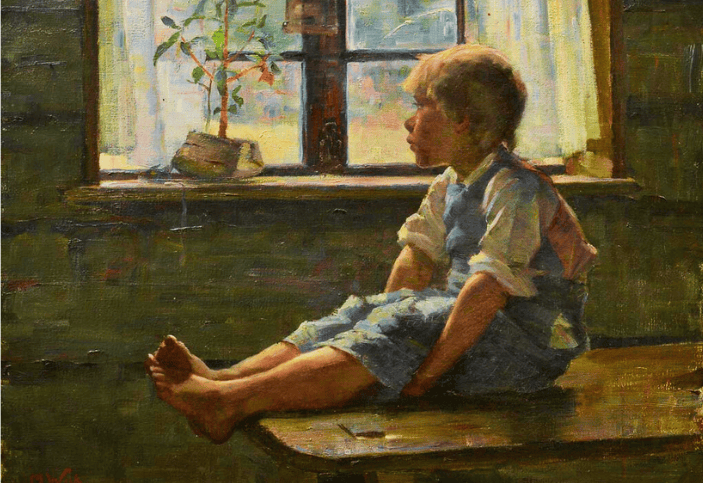
But to make matters worse, many boys are also growing up absent a father. We live in the age of the absent father. And father absence is a major factor in the infantilization of men.
“As well intentioned as most mothers are, they can hardly be expected to initiate their sons into something they are not. Without a father…the son stays a boy, trapped in dependency.”
James Hollis, Under Saturn’s Shadow
“…for a boy to become possessed of his own masculinity, he requires a lasting, intimate relationship with an effectively masculine father-figure. It follows that absence or masculine deficiency on the part of the father will leave the boy uninitiated into the masculine world.”
Anthony Stevens, Archetype Revisited: An Updated Natural History of the Self
An Absent Father Tends to Produce a Devouring Mother
When a husband is physically or emotionally absent, a woman must satisfy her emotional and intimacy needs elsewhere, which she can try to do through her children – particularly her son. A mother who does this subjects her son to what the psychologist Kenneth Adams called covert emotional incest.
“Covert incest occurs when a child becomes the object of a parent’s affection, love, passion, and preoccupation. The parent, motivated by the loneliness and emptiness created by a chronically troubled marriage or relationship, makes the child a surrogate partner.”
Kenneth Adams, Silently Seduced: When Parents Make Their Cihldren Partners
The Devouring Mother – Cripples her Son’s Masculinity
The devouring mother cripples her son’s masculinity by raising him to be a coward who is so afraid of life that he never leaves her.
“When a mother’s emotional needs are satisfied only by her son, she will not be able to tolerate his natural separations. She will greet his efforts to venture outward with various forms of discouragement and disapproval.”
Kenneth Adams, When He’s Married to Mom
“Masculine spontaneity is what the mother who intends to keep, or destroy, her son, instinctively fights.”
Marie-Louise von Franz, The Problem of the Puer Aeternus
“In my studies of adolescents who had an impaired sense of self, I found that many though not all of them had mothers who themselves suffered from an impaired self. The mothers too feared separation, and attempted to prevent it at all costs.”
James F. Masterson, Search for the Real Self
The psychologist Adam O. Hill notes that devouring mothers are very common in Japan. This can partially account for the plethora of hikikomori – young men who withdraw from social life for extended periods, sometimes months or years, rarely leaving their room or home. According to Adams and Hill, Japanese mothers:
“…live vicariously through their offspring…especially their sons. . . . Japanese mothers commonly view their children as an extension of themselves. . . . Since marriage offers so little in the way of satisfaction, they may also bind their children to them in a desperate effort to find some measure of pleasure, solace, and comfort. . . . Lacking [satisfaction] in marriage, Japanese mothers discover substitute satisfactions with their offspring. . . . Independent existence [for the son] is unacceptable.”
Adam O. Hill
The Psychology of the Man-Child – 6-part Series!

This is just a small sample of the type of content included in our 6-part series on the Psychology of the Man-Child. This series consists of over 2 hours of content and is accompanied by some of the greatest artwork in history to bring the ideas to life.
Join our membership to gain immediate access (you can cancel at anytime) – https://academyofideas.com/members/
Here’s what’s included in the series (all videos are downloadable and accompanied by transcripts):
- Chapter 1 – The Psychology of Mother Dependence
- Chapter 2 – Why Boys Must Suffer to Become Men
- Chapter 3 – Why Fatherless Boys Struggle to Become Men
- Chapter 4 – The Psychology of the Devouring Mother
- Chapter 5 – The Negative Mother Complex – The Unconscious Forces that Cripple Men
- Chapter 6 – How to Overcome a Mother Complex – The Hero’s Fight with the Dragon
Absent Father + Devouring Mother – Maximum Risk for Developing a Negative Mother Complex
“One cause for neurotic development can lie in the fact that a boy has a loving, but overindulgent or domineering mother, and a weak and uninterested father.”
Erich Fromm, The Art of Loving
“If the mother, because she is lonely or has an uninterested husband, chooses to override the instruction to attenuate the mother–son bond, or if the child through anxious attachment cannot bring itself to break away… then a relationship appropriate to childhood is pathologically perpetuated into maturity… A son trapped in this position cannot break free. Psychologically speaking, he is locked in the mother, devoured by his mother complex.”
Anthony Stevens, Archetype Revisited
The Mother Complex – A Cluster of Regressive Energies Beyond the Control of the Ego
“Always he imagines his worst enemy in front of him, yet he carries the enemy within himself—a deadly longing for the abyss, a longing to drown in his own source, to be sucked down to the realm of the Mothers.”
Carl Jung, Symbols of Transformation

“The Terrible Mother, the all-inclusive symbol of this devouring aspect of the unconscious, is therefore the Great Mother of all monsters. All dangerous affects and impulses, all the evils which come up from the unconscious and overwhelm the ego with their dynamism, are her progeny…When one knows how the Terrible Mother wreaks her vengeance in the myths, one can see [that]….in every case the central fact is…the overpowering of the ego by subterranean [i.e., unconscious] forces.”
Erich Neumann, The Origins and History of Consciousness
A Mother Complex Can Lead to:
Pathological Dependence on the Mother in Adulthood
“If this situation is dramatized…then there appears before you on the psychological stage a man living regressively, seeking his childhood and his mother, fleeing from a cold cruel world which denies him understanding. Often a mother appears beside him who apparently shows not the slightest concern that her little son should become a man, but who, with tireless and self-immolating effort, neglects nothing that might hinder him from growing up and marrying. You behold the secret conspiracy between mother and son, and how each helps the other to betray life.”
Carl Jung, Aion
Pathological Dependence on a Girlfriend or Wife – The Surrogate Mother
“After having married, as Jung once said of such a man, “He curled up in his little basket like a nice little dog and never moved again.” They never move again…and they generally marry (even though she may be beautifully disguised in youth) a devouring-mother type of woman. If she is not already that, they force her into the role by being submissive and boylike and sonlike.”
Marie-Louise von Franz, The Problem of the Puer Aeternus
M. Scott Peck recounts the extreme case of one such man, Hartley, who developed a pathological dependence on a surrogate mother.
“Hartley, the weak one, could not have survived in his infantile state without Sarah to make his every decision for him. But Sarah also could not have survived psychologically without Hartley’s weakness to feed her narcissistic need for domination and superiority. They functioned not as two separate individuals but as a single unit. Sarah had engulfed Hartley by mutual consent to the point where he had no will or identity of his own except that small little bit remaining that was reflected in his feeble suicide attempts. He had largely forsaken his ego boundaries, and she had incorporated them into her own…His relationship with Sarah was that of an infant clinging to its mother.”
M. Scott Peck, The People of the Lie
Pornography Addiction

. . .clinicians in national inpatient addiction treatment programs have estimated in informal surveys that up to 40 percent of male sex addicts have enmeshment issues with their mothers. Further, this enmeshment is seen as a significant factor in their sexually addictive behavior.
Kenneth Adams, When He’s Married to Mom
“…if a man gets stuck indulging in wishful sexual fantasies, he literally falls into the hands of the vampire or, psychologically, the devouring mother. He loses his capacity to take his own life in hand. He loses his willpower. He loses his male efficiency and just daydreams all the time about women and their curves and would-be romantic adventures. He lives an unreal life. Once I saw a man, forty-three years old, who had never approached a woman. He was still living with his mother. I asked him, “What on earth are you doing with your sexuality?” He gave a secretive smile and didn’t confess, but I knew he just masturbated wildly every night…In a primitive tribe, one would say such a man had been bewitched. He is bewitched.”
Marie-Louise von Franz, The Way of the Dream
A Provisional Life
The man with a mother complex lives what the psychologist H.G. Baynes called a “provisional life”. The word provisional means “arranged or existing for the present, possibly to be changed later”. And one of the defining traits of the man with a negative mother complex is that he leaves himself an easy exit out of any and all goals, projects, commitments, relationships, and plans.. He engages in what Marie-Louise von Franz called “everlasting switching” – he jumps from one life-plan, relationship, and project to the next, but he never settles on one long enough to achieve any semblance of success.
“He never quite touches the earth. He never quite commits himself to any mundane situation but just hovers over the earth, touching it from time to time…in every field of work there always comes the time when routine must be faced. All work, even creative, contains a certain amount of boring routine, and that is where the [man with a negative mother complex] escapes and comes to the conclusion again that “this is not it!””
Marie-Louise von Franz, The Problem of the Puer Aeternus
The Psychology of the Man-Child – 6-part Series!

This is just a small sample of the type of content included in our 6-part series on the Psychology of the Man-Child. This series consists of over 2 hours of content and is accompanied by some of the greatest artwork in history to bring the ideas to life.
Join our membership to gain immediate access (you can cancel at anytime) – https://academyofideas.com/members/
Here’s what’s included in the series (all videos are downloadable and accompanied by transcripts):
- Chapter 1 – The Psychology of Mother Dependence
- Chapter 2 – Why Boys Must Suffer to Become Men
- Chapter 3 – Why Fatherless Boys Struggle to Become Men
- Chapter 4 – The Psychology of the Devouring Mother
- Chapter 5 – The Negative Mother Complex – The Unconscious Forces that Cripple Men
- Chapter 6 – How to Overcome a Mother Complex – The Hero’s Fight with the Dragon
1 comment
Leave a comment
Only members can post comments. Login, or become a member, to post a comment.

It is difficult for boys to become men because they are taught to live in accordance with their memories, which is the past.
To become men boys must learn to see the present, which they were not taught as boys, to dismiss the influence of their memories in the running of their lives.
To see the present boys need to shift their attention from their thoughts and memories to their perceptions of their environment, thoughtlessly.
This way the boys will see life as it is instead of seeing life as they think it is, which is manly as it relieves the boys of the influence of their conditioning, their memory, that has been preventing them from maturing.